
DVA Dental Implants — What Veterans Need to Know
If you are an Australian veteran with a DVA card and you have missing teeth, dental implants may be covered by DVA. But the process is different from a standard private patient, and understanding how it works before you walk in saves time and avoids surprises.
At Compass Dental Care in Darwin, we regularly handle DVA implant cases — from the initial assessment through to the prior approval application and the final restoration.
Can DVA Cover Dental Implants?
Yes. Dental implants are covered under DVA for Gold Card holders when there is a clear clinical need. They fall under Schedule C of the DVA dental fee schedule.
For White Card holders, implants are covered only if the missing teeth are related to an accepted service condition.
Implants are not automatically approved — they require prior approval from DVA before treatment can begin. This is because implants are a higher-cost treatment and DVA needs to assess whether they are the most clinically appropriate option for your situation.
The Prior Approval Process
Here is how it works at Compass Dental:
-
We assess your situation. Dr Thien Pham examines your mouth, takes 3D imaging (CBCT scan), and determines whether implants are the best option for you versus alternatives like dentures or bridges.
-
We prepare the application. We write a detailed treatment plan with clinical justification explaining why implants are the appropriate treatment. This includes X-rays, photographs, and a clear rationale.
-
We submit to DVA. The application goes to DVA’s Health Approvals team. You do not need to do anything — we handle the paperwork.
-
DVA assesses and responds. This typically takes 2 to 4 weeks. DVA may approve the treatment in full, approve a modified plan, or request additional information.
-
Treatment proceeds once approved. Once we have DVA approval, we schedule your implant surgery. DVA is billed directly — there is no cost to you for approved treatment.
The Schedule C Biennial Monetary Limit
Implants fall under Schedule C, which has a Biennial Monetary Limit (BML) — currently $5,980.30 for the period 1 January 2026 to 31 December 2027.
This means DVA will cover up to $5,980.30 of Schedule C treatment over that two-year period. For a single implant, this is generally sufficient. For multiple implants or complex cases, we may need to stage the treatment across biennial periods or seek an BML exemption if there are exceptional clinical circumstances.
We discuss all of this with you upfront so there are no surprises.
When Are Implants Approved vs Declined?
DVA generally approves implants when:
- There is a clear clinical benefit over dentures or bridges
- The patient has adequate bone density (or bone grafting is clinically justified)
- The patient’s general health supports implant surgery
- The missing teeth affect function (chewing, speech) or there is a risk of further tooth loss
DVA may decline or request alternatives when:
- A simpler restoration (bridge, denture) would achieve the same clinical outcome
- There are medical contraindications
- The request exceeds the BML without clinical justification for exemption
If DVA requests an alternative approach, we discuss the options with you and help you decide how to proceed.
What Does DVA Implant Treatment Include?
A typical single-tooth implant case involves:
- Consultation and 3D imaging — assessment, CBCT scan, treatment planning
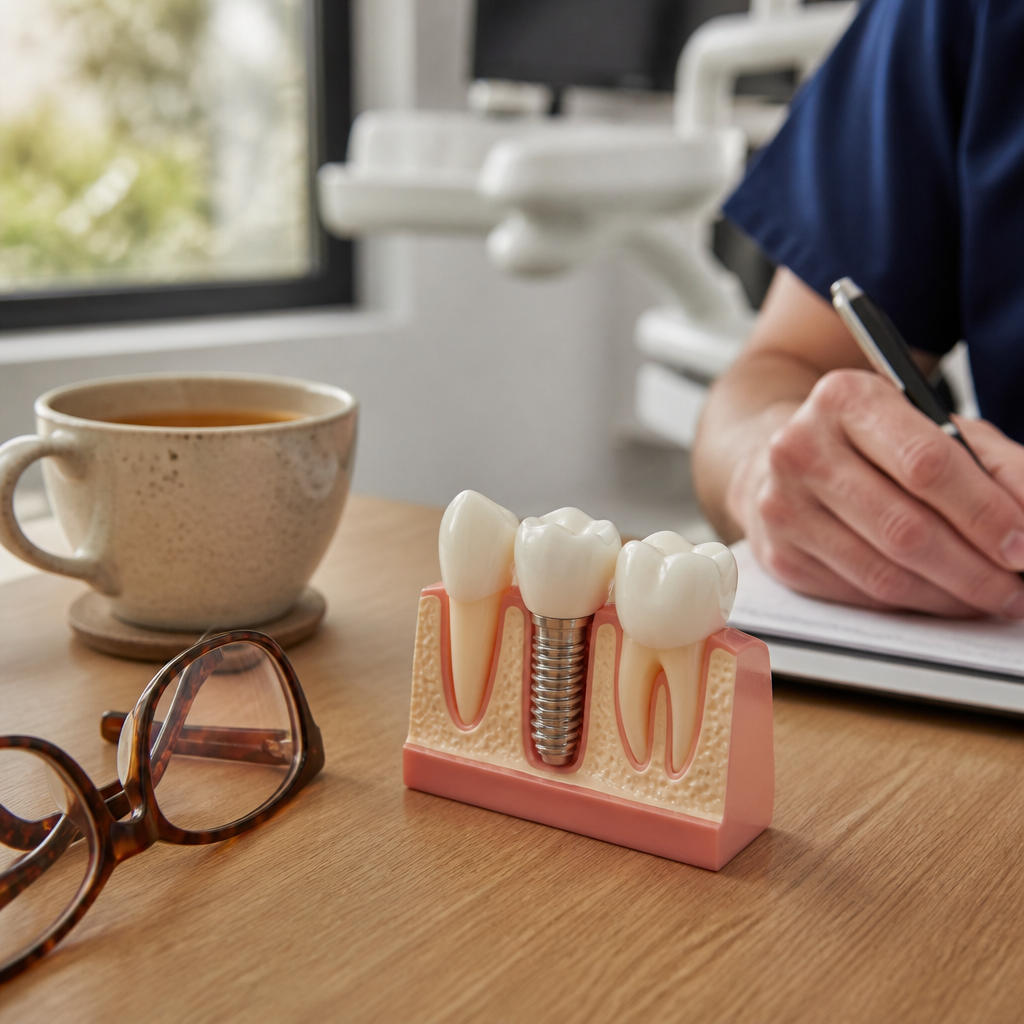
- Implant fixture placement — the titanium post is surgically placed into the jawbone under local anaesthetic with happy gas available for comfort
- Healing period — 3 to 6 months for the implant to integrate with the bone
- Second-stage surgery — a minor procedure to expose the top of the implant
- Abutment and crown — the custom-made crown is fitted to the implant
For Gold Card holders, all of these stages are covered by DVA when the treatment has been approved.
Who Is Allowed to Perform Each Phase
DVA’s Osseo-integrated Dental Implant Policy splits implant treatment into a surgical phase and a restorative phase, and specifies who may provide each:
| Treatment | Surgical phase | Restorative phase |
|---|---|---|
| Single tooth implant | Oral and maxillofacial surgeon, oral surgeon or periodontist | Prosthodontist or dentist |
| Incisor replacement with a pontic | Oral and maxillofacial surgeon, oral surgeon or periodontist | Prosthodontist or dentist |
| Implants for a full lower denture | Oral and maxillofacial surgeon, oral surgeon or periodontist | Prosthodontist only |
| Implants for a partial upper denture | Oral and maxillofacial surgeon, oral surgeon or periodontist | Prosthodontist only |
In practice this means the surgical placement is always referred to a specialist under DVA funding — that is policy, not a practice preference. The restorative phase, fitting the crown or restoration to the implant, can be completed by a general dentist for a single tooth implant or an incisor replaced with a pontic. Implants supporting dentures require a prosthodontist for the restorative phase.
DVA also requires that your dentition and oral health have been stable for more than six months, including any periodontal disease, with risk factors such as smoking and osteoporosis suitably controlled. Implants are funded where clinically necessary, not for cosmetic purposes alone.
Bone Grafting and Additional Procedures
Some implant cases require bone grafting if there is insufficient bone to support the implant. Bone grafting is also covered by DVA when clinically necessary and forms part of the prior approval application.
Sinus lifts, socket preservation, and other preparatory procedures may also be required and covered as part of the overall implant treatment plan.
How Long Does the Process Take?
From initial consultation to final crown:
- Prior approval: 2 to 4 weeks
- Implant placement to final crown: 3 to 6 months (healing time)
- Total from start to finish: approximately 4 to 8 months
We keep you informed throughout and schedule each stage when you are ready.
Emergency Situations
If you lose a tooth due to trauma or sudden dental failure, contact us immediately. We can place a temporary solution while the DVA prior approval for the implant is processed. For genuine emergencies, DVA allows retrospective approval — we treat you first and sort the paperwork after.
Ready to find out if DVA covers implants for your situation?
Call us on (08) 8995 9530 or book a consultation. We will assess your situation, explain your options, and handle the entire DVA process for you.


