
Complete Guide to Wisdom Teeth Removal in Darwin
You have a dull ache at the back of your jaw that will not go away. Or your dentist just pointed at an X-ray and said “those wisdom teeth need to come out.” Or maybe you are 19, nothing hurts, and your mum is telling you to get them checked before they become a problem.
Whatever brought you here, this guide covers everything — the honest version. When wisdom teeth actually need to come out, when they do not, what happens during the procedure, what it costs at our Darwin practice, and what recovery really looks like day by day.
At Compass Dental Care in Parap, we remove wisdom teeth in the chair under local anaesthetic with happy gas (nitrous oxide) available for comfort. Dr Thien Pham has been doing this for over a decade, and most cases are finished within the hour. The ones we do not feel are right for our chair get referred — and we will explain when and why further down.
Not sure if yours need to come out? Take the free online 3-minute assessment to find out based on your symptoms — no appointment needed.
What Are Wisdom Teeth?
Wisdom teeth — clinically called third molars — are the last teeth to develop, usually appearing between the ages of 17 and 25. Most adults have four (one in each corner of the mouth), though some people have fewer, and some have none at all.
According to Healthdirect Australia, wisdom teeth are the last of the adult teeth to come through and often cause problems because there is not enough room in the jaw for them to emerge properly. That is not a defect in your mouth — human jaws have shortened over thousands of years while the teeth themselves have not caught up. The result is that many people simply do not have the space for four more molars at the back.
Here in Darwin, we see this across all ages. University students at CDU dealing with their first flare-up. Defence personnel posted to Robertson Barracks who need it sorted before deployment. Families in Palmerston and Casuarina whose teenagers are starting to feel pressure at the back. Tradespeople from Winnellie and Stuart Park who have been putting it off for years because they cannot afford the downtime. The story varies, but the question is the same: do they actually need to come out?
When Wisdom Teeth Need to Come Out
Not all wisdom teeth need removal. If yours have come through fully, sit straight, are not causing pain, and you can reach them with a toothbrush, they can stay. Healthdirect Australia recommends a conservative, symptom-based approach — removal is indicated when the teeth are causing problems, not as a routine preventive measure.
At Compass Dental Care, we take the same position. We will never recommend pulling a healthy, well-positioned wisdom tooth “just in case.” But when there is a genuine problem, waiting usually makes it worse. Here are the situations where removal is the right call.
Pericoronitis — The Most Common Reason
Pericoronitis is a painful infection of the gum tissue surrounding a partially erupted wisdom tooth. It happens when food and bacteria get trapped under the flap of gum (the operculum) covering a tooth that has only partially broken through.
Symptoms include:
- Throbbing pain at the back of the jaw, often radiating to the ear
- Swelling and redness of the gum tissue
- A bad taste in the mouth or persistent bad breath
- Difficulty opening the mouth fully (trismus)
- In severe cases, swelling of the face, fever, and difficulty swallowing
Pericoronitis is especially common in Darwin’s warm, humid climate, where bacterial growth is faster and infections can escalate quickly. Healthdirect Australia notes that pericoronitis is one of the most common reasons wisdom teeth need to be removed.
If you have had one episode of pericoronitis, there is a high chance it will recur. We can sometimes manage the first episode with antibiotics and irrigation, but if it comes back, removal is usually the most sensible long-term solution.
Impacted Wisdom Teeth
An impacted wisdom tooth is one that does not have enough room to emerge normally. It may be angled sideways against the neighbouring tooth (mesioangular impaction), tilted backwards (distoangular), or completely buried within the jawbone (horizontal or vertical impaction).
According to Healthdirect Australia, impacted wisdom teeth can cause pain, infection, damage to adjacent teeth, and cyst formation — even if they are not currently causing symptoms. This is why your dentist may recommend removal based on X-ray findings alone.
Types of impaction:
- Soft tissue impaction — the tooth has partially emerged through bone but the gum still covers part of it. This is the setup for pericoronitis.
- Partial bony impaction — the tooth is partially trapped in the jawbone. Often the most complex to extract.
- Full bony impaction — the tooth is completely enclosed in bone. May or may not cause symptoms, but carries a risk of cyst formation over time.
Decay on the Wisdom Tooth or Its Neighbour
Because wisdom teeth sit so far back, they are hard to clean properly. Decay often develops silently — on the wisdom tooth itself, or on the back surface of the second molar next to it. Once a cavity forms on the adjacent tooth because of a poorly positioned wisdom tooth, the wisdom tooth needs to come out to save the neighbour.
This is one of the most frustrating scenarios we see, because it is entirely preventable with timely removal. We regularly see patients from across Darwin — Nightcliff, Fannie Bay, Rapid Creek — who come in for a routine check-up and discover that a wisdom tooth they forgot about has been quietly damaging the molar next to it.
Cyst Formation
In rare cases, the sac of tissue surrounding an impacted wisdom tooth fills with fluid and forms a dentigerous cyst. Left untreated, a cyst can hollow out the jawbone and damage surrounding structures. This is usually detected on an OPG X-ray during a routine check-up.
Crowding and Shifting
The degree to which wisdom teeth cause crowding of the front teeth is debated in dentistry. However, partially erupted wisdom teeth can contribute to localised shifting, and if you have had orthodontic treatment (braces or clear aligners), your orthodontist may recommend wisdom tooth removal to protect the result.
When Wisdom Teeth Do NOT Need to Come Out
We are upfront about this: not every wisdom tooth is a problem. If any of the following apply, we will tell you to leave them alone and monitor at your regular check-ups.
- They have fully erupted and sit in a good position
- They are not causing pain, infection, or damage to adjacent teeth
- You can clean them properly — your toothbrush and floss can reach them
- X-rays show no cysts, pathology, or concerning root proximity to nerves
- They are completely buried with no history of symptoms and no radiographic signs of trouble
Routine prophylactic removal of healthy, asymptomatic wisdom teeth is not something we recommend. The Australian Dental Association’s position aligns with this — removal should be based on clinical findings, not fear of what might happen.
Want to check your own situation? Take the free online wisdom teeth assessment — 15 questions, 3 minutes, instant personalised results.
The Procedure: What Actually Happens
Understanding the process takes the fear out of it. Here is exactly what happens when you have wisdom teeth removed at Compass Dental Care in Parap, Darwin.
Step 1: Consultation and X-rays
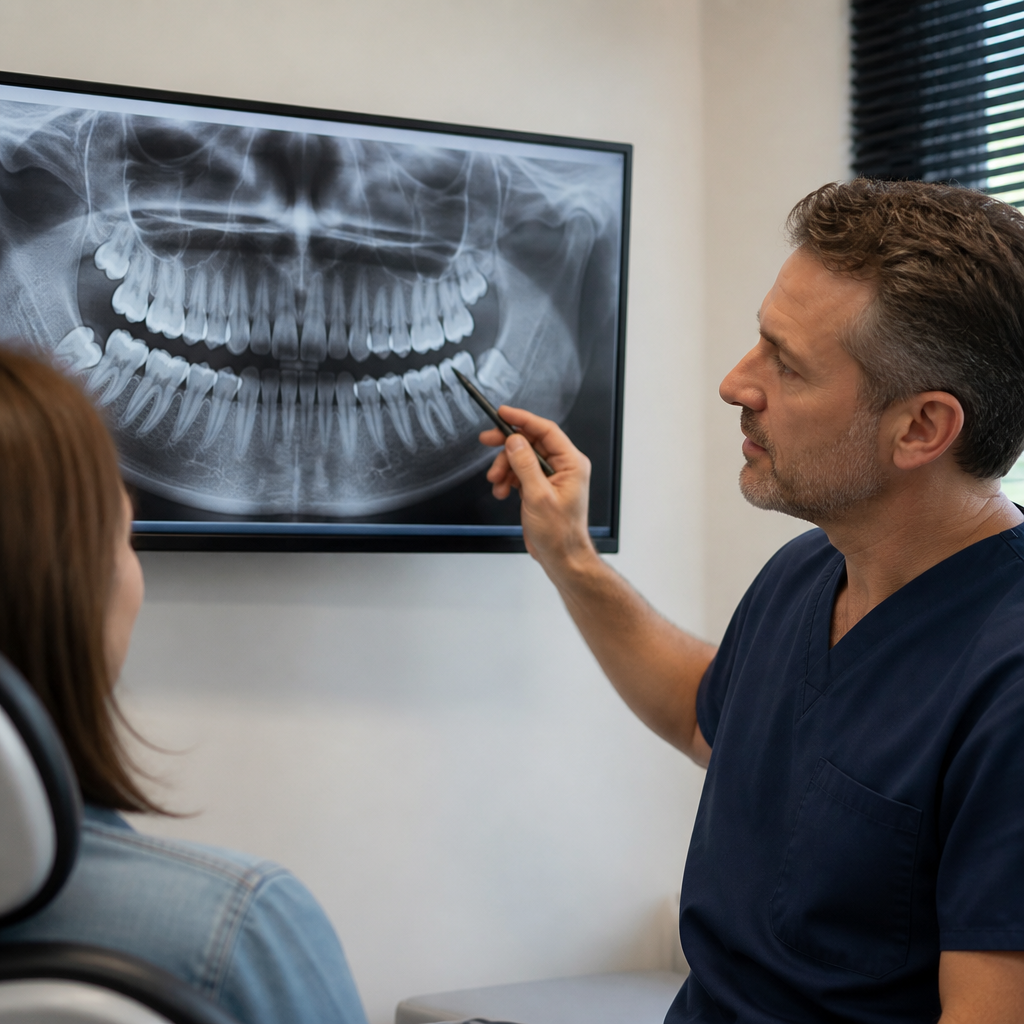
Your first visit is about assessment, not treatment. We take an OPG X-ray ($121) — a panoramic image of your entire jaw that shows the position of all four wisdom teeth, their root shape, and their relationship to the inferior alveolar nerve (the main nerve running through the lower jaw). In complex cases, we may also take a CBCT scan ($200–$270) for a three-dimensional view.
Dr Thien Pham will explain what the X-ray shows in plain language, recommend a treatment plan, and give you an itemised written quote. If your teeth do not need to come out, we will tell you.
Step 2: The Day of the Procedure
On the day, you do not need to fast (we do not use general anaesthetic or IV sedation). Eat a normal breakfast or lunch beforehand — it actually helps.
- Local anaesthetic is injected around the wisdom tooth to numb the area completely. You will feel pressure but no pain.
- Happy gas (nitrous oxide) is available if you would like extra relaxation. It is breathed through a comfortable nose mask and produces a calm, floaty feeling. You remain fully conscious and can respond to instructions. The effects wear off within minutes once the mask is removed.
- For a simple extraction (tooth fully erupted), the tooth is loosened with an elevator instrument and removed with forceps. This typically takes 10–20 minutes per tooth.
- For a surgical extraction (tooth partially or fully impacted), a small incision is made in the gum. If bone is covering the tooth, a small amount is removed. The tooth may be divided into sections to make removal easier and less invasive. This takes 20–45 minutes per tooth depending on complexity.
- The area is cleaned, and dissolvable stitches are placed if needed.
Most patients are surprised by how quick and straightforward it is. Even removal of all four wisdom teeth in a single session is commonly done under local anaesthetic and happy gas — it avoids the need for a second round of recovery.
Step 3: Before You Leave
You go home with a printed aftercare sheet, gauze pads, and clear instructions on pain management. If you had happy gas only (no IV sedation), you can usually drive yourself home after a 15-minute wait. We recommend having someone available if you are anxious.
When We Refer to a Specialist
We handle the majority of wisdom teeth extractions in our Parap practice, including surgical cases. However, some cases are genuinely better managed by an oral and maxillofacial surgeon in a hospital setting.
We will refer you if:
- The roots are very close to or wrapped around the inferior alveolar nerve (high risk of temporary or permanent numbness)
- You need general anaesthetic due to severe dental phobia that happy gas cannot manage, complex medical conditions, or multiple deeply impacted teeth in a high-risk position
- The case involves a large cyst or unusual pathology
- You are on medications (e.g. bisphosphonates for osteoporosis) that increase the risk of jaw complications
In Darwin, complex cases are typically referred to the Oral and Maxillofacial Surgery Department at Royal Darwin Hospital or to private specialist oral surgeons. We arrange the referral and send your X-rays — you do not need to start from scratch.
Being honest about our scope is important to us. We would rather refer a case that is outside our comfort zone than attempt something that carries unnecessary risk.
Recovery: What to Expect Day by Day
Recovery varies from person to person, but here is a realistic timeline based on what we see in our Darwin patients.
Day 1: The First 24 Hours
- Bleeding is normal for the first few hours. Bite gently on gauze — replace every 30–45 minutes as needed. A small amount of blood-tinged saliva is normal overnight.
- Swelling begins to develop, typically peaking at 48–72 hours. Apply an ice pack to the outside of your cheek — 20 minutes on, 20 minutes off — during the first day.
- Rest. No gym, no running, no heavy lifting. Keep your head elevated.
- Eat soft, cool foods. Yoghurt, mashed potato, smoothies (no straw), soup that has cooled. Avoid anything hot — heat increases blood flow and can restart bleeding.
- Pain management. Paracetamol and ibuprofen taken together (at staggered intervals) are highly effective. Take them before the anaesthetic wears off so you stay ahead of the pain. Your dentist may also prescribe stronger medication for the first day or two.
Days 2–3: Peak Swelling
This is usually the worst of it. Swelling and bruising may look alarming — some patients develop bruising along the jawline or even down the neck. This is normal, especially after surgical extractions, and does not indicate a complication.
- Switch from ice packs to warm compresses to encourage blood flow and reduce swelling.
- Begin gentle salt water rinses (half a teaspoon of salt in warm water) after meals. Do not spit forcefully — let it fall from your mouth.
- Continue soft foods and stay hydrated. Darwin’s heat means you lose more fluid than you think — keep water close.
Days 4–7: Turning the Corner
- Pain and swelling should be noticeably decreasing each day.
- Gradually introduce firmer foods as comfort allows. Avoid hard, crunchy, or sharp foods (chips, nuts, crusty bread) that could irritate the extraction site.
- Dissolvable stitches will start to come away on their own. Do not pull at them.
- Most people return to desk work or study by day 2–3. Physically demanding jobs (construction, hospitality, defence) may need the full week.
Weeks 2–4: Mostly Healed
- The gum surface is mostly closed over. You can return to normal eating and exercise.
- The underlying bone continues to remodel for several months, but this happens beneath the surface and does not affect daily life.
Dry Socket — What It Is and How to Avoid It
Dry socket (alveolar osteitis) is the most common complication after wisdom teeth removal. It occurs when the blood clot that protects the extraction site is dislodged or dissolves too early, exposing the bone underneath.
Symptoms: a deep, throbbing ache starting 2–4 days after the extraction that does not respond well to normal pain relief. Sometimes a bad taste or visible empty socket.
How to avoid it:
- Do not smoke. Smoking is the single biggest risk factor. Avoid for at least 72 hours — ideally a full week.
- Do not use straws. The suction can dislodge the clot.
- Do not rinse vigorously for the first 24 hours.
- Do not poke at the site with your tongue, finger, or toothbrush.
If you think you have dry socket, call us. We will pack the socket with a medicated dressing (Alvogyl) and the pain typically improves within hours. Dry socket is annoying but treatable — it does not cause lasting damage.
Wisdom Teeth Removal Cost in Darwin
We believe in transparent pricing. Here is what wisdom teeth removal costs at Compass Dental Care in Parap — no surprises.
Our Fees (per tooth)
| Procedure | ADA Code | Fee |
|---|---|---|
| Consultation (initial assessment) | 013/014 | $98 |
| Simple extraction (tooth fully erupted) | 311 | $295 |
| Sectional removal (tooth needs to be divided) | 314 | $351 |
| Surgical removal — no bone removal | 322 | $418 |
| Surgical removal — with bone removal | 323 | $454 |
| Surgical removal — bone removal + tooth division | 324 | $587 |
| Happy gas (nitrous oxide) — per 30 minutes | 943 | $144 |
| OPG X-ray (panoramic) | 037 | $121 |
| CBCT scan (3D imaging, if needed) | 026 | $200 |
What a Typical Case Costs
- One simple upper wisdom tooth: $98 (consultation) + $121 (OPG) + $295 (extraction) = about $514
- One surgical lower wisdom tooth with happy gas: $98 (consultation) + $121 (OPG) + $454 (extraction) + $144 (happy gas) = about $817
- All four wisdom teeth (mix of simple and surgical) with happy gas: $98 (consultation) + $121 (OPG) + extractions + happy gas = approximately $1,600–$2,400 depending on complexity.
We give you an itemised written quote after your consultation — before any procedure is booked. If something changes clinically during treatment (e.g. a tooth that looked simple on X-ray turns out to need a surgical approach), we explain and re-quote before proceeding.
Health Insurance, Medicare, and CDBS
Private health insurance: If you have extras cover that includes major dental, your fund will typically rebate a portion of the extraction fee. The amount varies by fund and level of cover. We process claims on the spot with HICAPS, so you know your gap payment immediately.
Medicare: Standard wisdom teeth removal is not covered by Medicare. However, if your wisdom teeth are removed in a hospital under general anaesthetic by an oral surgeon, Medicare may cover the hospital and anaesthetist fees (not the surgeon’s fee). This applies only to hospital-based procedures, not in-chair removal.
Child Dental Benefits Schedule (CDBS): The CDBS covers up to $1,158 in dental services over two years for eligible children aged 0–17. Simple wisdom tooth extractions (code 311) are covered under CDBS. Surgical extractions (codes 322–324) are not typically covered. Check eligibility with Medicare or ask our reception team.
Payment plans: Zip Pay and Zip Money are available at Compass Dental Care. We want to make sure cost is not the reason you delay treatment — especially when waiting makes the extraction more complex and more expensive.
Why Darwin Patients Choose Compass Dental
Local Experience
We have been in Parap for over a decade, looking after patients from across Darwin and the wider NT — Stuart Park, Fannie Bay, Nightcliff, Casuarina, Rapid Creek, Palmerston, Winnellie, Larrakeyah, and surrounding communities. Many of our patients are second-generation — they came in as teenagers, and now their kids are sitting in the same chair.
In-Chair, Not Hospital
We do most wisdom teeth extractions in the dental chair under local anaesthetic and happy gas. That means no hospital admission, no fasting, no general anaesthetic recovery, and significantly lower cost. For the majority of cases, this is all that is needed — and patients consistently tell us it was far less daunting than they expected.
Honest Assessment
If your wisdom teeth do not need to come out, we will say so. If they need a specialist, we will tell you that too. Our business does not depend on pulling teeth that do not need pulling.
Convenient Location
Compass Dental Care is at Suite 102/12 Salonika St, Parap NT 0820. We are a short drive from Darwin CBD, Stuart Park, and Fannie Bay, and easy to reach from Palmerston, Nightcliff, and Casuarina. Street parking is available on Salonika Street.
Hours: Monday–Friday 9am–5pm, Saturday 8:30am–12:30pm.
Patients Travelling from Regional NT
We regularly see patients who travel from Katherine, Alice Springs, Tennant Creek, and remote NT communities for dental treatment. If you are planning a trip to Darwin for wisdom teeth removal, contact us and we will schedule your consultation and procedure to minimise the number of visits needed. For straightforward cases, we can often do the assessment and extraction in a single appointment.
Frequently Asked Questions
How do I know if my wisdom teeth are impacted?
An impacted wisdom tooth may cause pain, swelling, or a bad taste at the back of your mouth — but many impacted teeth cause no symptoms at all. That is why regular dental check-ups with X-rays are important. An OPG X-ray shows the exact position of all four wisdom teeth and whether they are impacted, angled, or at risk of causing problems. If you are unsure, take our free online assessment for a quick indication.
Is wisdom teeth removal painful?
During the procedure, no. Local anaesthetic numbs the area completely, and happy gas helps you feel relaxed and calm throughout. After the anaesthetic wears off, expect some soreness and swelling for 3–5 days. Most patients manage well with paracetamol and ibuprofen taken together. According to Healthdirect Australia, pain and swelling usually peak at one to two days and then start to improve.
How long does recovery take?
Most patients feel significantly better within 5–7 days. Swelling peaks at 48–72 hours and then gradually subsides. Many people return to work or study within 2–3 days for straightforward extractions. Physically demanding work may need the full week. Full healing of the underlying bone takes several weeks, but this does not affect your daily activities.
Do all four wisdom teeth need to come out at once?
Not necessarily. We assess each tooth individually. If only one or two are causing problems, we remove those and leave the others alone. If all four are problematic, doing them together avoids multiple recovery periods — and most patients prefer to get it done in one go.
What age should wisdom teeth be removed?
Wisdom teeth typically emerge between ages 17 and 25. According to Healthdirect Australia, removal is generally easier in younger patients because the roots are not fully formed and the bone is less dense. However, there is no upper age limit — we remove wisdom teeth for patients of all ages when clinically indicated.
Can I drive myself home afterwards?
Yes, in most cases. We use local anaesthetic and happy gas (not general anaesthetic or IV sedation), so you are fully alert after the procedure. If you have had happy gas, wait 15 minutes before driving. We recommend having someone available if you are particularly anxious.
What happens if I do not get my wisdom teeth removed?
If a wisdom tooth is actively causing problems — recurring infections, decay, pain — delaying removal typically makes things worse. Infections can spread. Decay can damage the neighbouring tooth. Roots continue to develop, making extraction more complex. That said, if your wisdom teeth are healthy and not causing problems, there is no urgency. We monitor them at your regular check-ups and recommend removal only if something changes.
What is the difference between local anaesthetic, happy gas, and general anaesthetic?
Local anaesthetic is an injection that numbs the area around the tooth. You are fully awake and feel no pain — only pressure. Happy gas (nitrous oxide) is a mild sedative breathed through a nose mask. It makes you feel relaxed and slightly floaty, but you remain conscious and can respond normally. The effects wear off within minutes. General anaesthetic puts you completely to sleep and requires a hospital setting, fasting, and monitored recovery. We use local anaesthetic and happy gas at Compass Dental Care — not general anaesthetic. For the vast majority of wisdom teeth cases, this is all that is needed.
This guide was written by Dr Thien Pham at Compass Dental Care, Parap, and is current as of 2026. Prices quoted are a guide and may vary depending on individual circumstances. This information is general in nature and does not replace a clinical assessment. If you have questions about your wisdom teeth or would like to book a consultation, call (08) 8995 9530 or take the free online assessment.


