
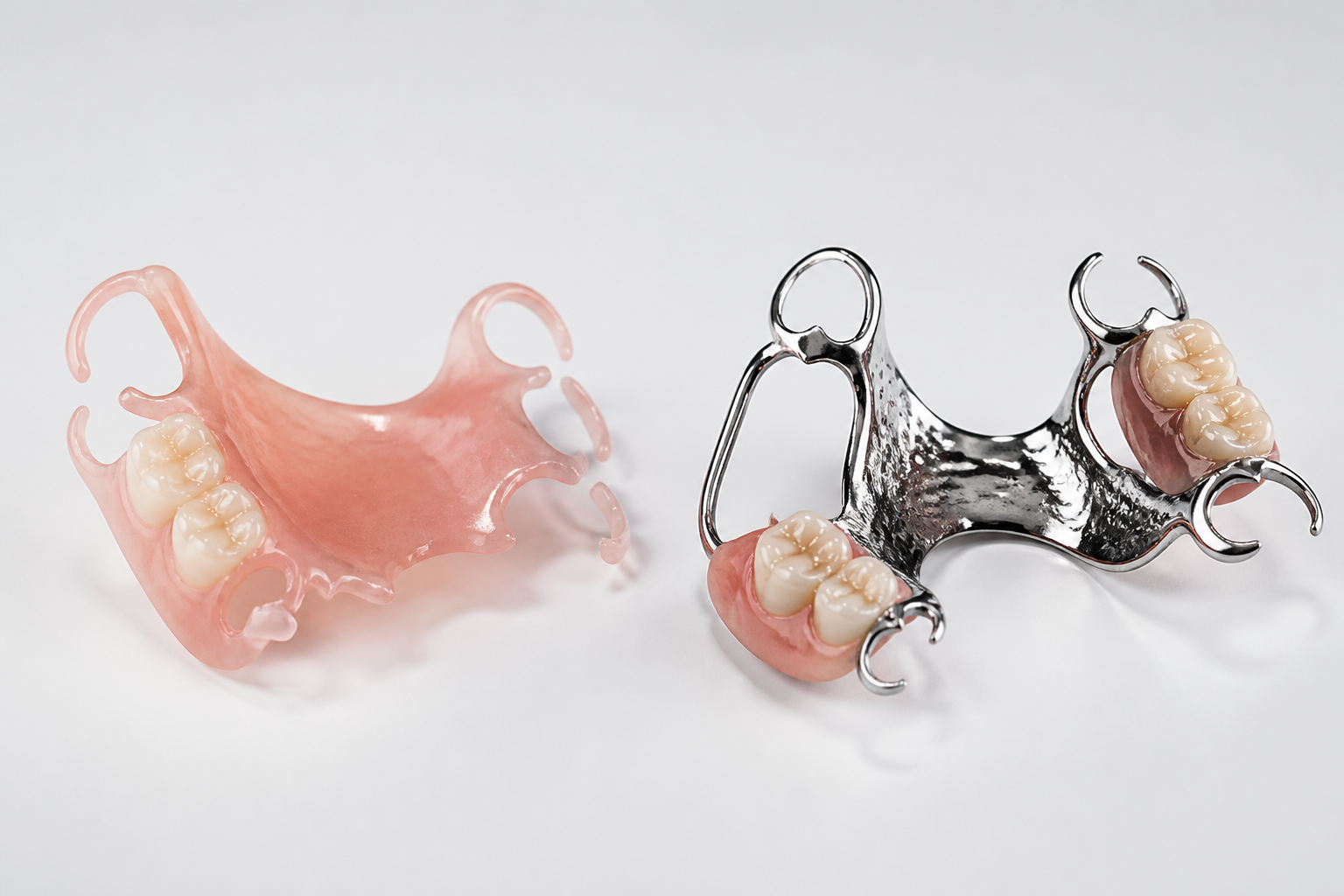
Valplast vs Chrome Dentures: Which Partial Denture Is Right for You?
A Balanced Guide to Flexible and Metal Partial Dentures in Darwin
When you’re missing a few teeth but still have healthy natural ones, a partial denture is one of the simplest ways to fill the gaps. But almost everyone who reaches this point asks the same thing: Valplast or chrome — which one is better?
The honest answer is that neither is universally better. They’re made of completely different materials, they behave differently in your mouth, and each one shines where the other struggles. A flexible Valplast denture can be the perfect solution for one person and the wrong choice for another. The real question isn’t “which is best” — it’s “which suits your mouth, your remaining teeth, and your priorities.”
This guide lays out both options fairly, with the genuine pros and trade-offs of each. You can see the full range on our Dentures in Darwin page, and the specifics of gap-filling on our Partial Dentures page.
What Is a Valplast (Flexible) Denture?
A Valplast denture is made from a flexible, metal-free nylon material. Instead of a rigid framework and metal clasps, it uses gum-coloured clasps that wrap gently around your natural teeth and blend into your gum line.
What people like about it:
- No visible metal. The clasps are the same pink as your gums, so there’s nothing that flashes silver when you smile or talk. For teeth near the front of the mouth, this is often the single biggest reason people choose it.
- Lightweight and flexible. It flexes slightly as you eat and speak, which many patients find comfortable and snug.
- Metal-free. It’s a good option where there’s a known sensitivity to metal — or to the acrylic used in conventional dentures.
The trade-offs to know:
- Harder to adjust over time. Valplast is difficult to reline or add teeth to. If you lose another tooth down the track, you’ll usually need a whole new denture rather than a simple modification.
- Can stain over time. The nylon material can pick up staining with the years, depending on diet and care.
- Best for smaller cases. It’s most suited to replacing a small number of teeth rather than spanning large gaps, where a more rigid design tends to perform better.
Try Valplast with confidence — our credit guarantee. Because a flexible denture doesn’t suit everyone, we take the risk out of trying one: if your Valplast denture doesn’t work out within 12 months, we credit its full cost towards a different treatment — a chrome denture, an implant-retained option, or whatever suits you better. You’re never left paying twice to get it right.
What Is a Chrome (Cobalt-Chromium) Denture?
A chrome denture — properly, a cobalt-chromium cast partial — is built around a thin, strong metal framework that’s custom-cast to your mouth. Despite the word “metal,” it’s remarkably slim and precise.
What people like about it:
- Thin and far less bulky. The cast framework is much slimmer than an acrylic or flexible denture, so it feels less intrusive.
- Covers less of your palate. Because the metal is strong, the design can leave much of the roof of your mouth open — which many patients find more comfortable and natural.
- Food tastes more natural. Metal conducts temperature, so you feel hot and cold through the denture and food tends to taste the way it should.
- Very durable and long-lasting. A well-made chrome framework is strong and holds up well over years of use.
- Precise grip. It’s designed to grip your remaining teeth accurately, which helps it stay put.
The trade-offs to know:
- Needs healthy teeth to anchor to. The framework relies on strong, healthy natural teeth to clasp onto. If those anchor teeth aren’t sound, chrome may not be the right fit.
- Clasps can sometimes show. Depending on where your remaining teeth sit, a metal clasp can occasionally be visible.
- Higher upfront cost. It typically costs more than an acrylic denture to make.
Valplast vs Chrome — Side by Side
| Valplast (flexible) | Chrome (cobalt-chromium) | |
|---|---|---|
| Material | Flexible metal-free nylon | Thin cast cobalt-chromium framework |
| Visible metal | None — gum-coloured clasps | Metal clasps can occasionally show |
| Comfort / bulk | Lightweight, flexible, snug | Very slim, covers less of the palate |
| Durability | Good; can stain over time | Very durable and long-lasting |
| Add teeth later | Difficult — usually needs a new denture | Anchors to healthy natural teeth; relies on them staying sound |
| Best suited to | Smaller gaps; metal/acrylic sensitivity; front-of-mouth aesthetics | Larger cases with healthy anchor teeth; long-term everyday wear |
| Guide price | From around $1,400 per denture | Approximately $1,800–$2,400 per denture |
These are indicative guide prices to help you plan. Your exact fee is confirmed in writing after your consultation with Dr Pham.
Which Should You Choose?
There’s no single right answer — but a few common scenarios point one way or the other:
- You mainly care about looks, and the gap is near the front. Valplast’s gum-coloured, metal-free clasps hide well, which is why it’s often chosen for visible areas.
- You have a known metal or acrylic sensitivity. Valplast’s metal-free build sidesteps that concern.
- You have healthy, strong natural teeth and want something durable for everyday long-term wear. Chrome’s slim, strong framework grips well and lasts.
- You want to taste food naturally and dislike a bulky denture covering your palate. Chrome conducts temperature and covers far less of the roof of your mouth.
- You expect you may lose more teeth over time. This is worth raising at your consultation — because Valplast is hard to add to, a plan that anticipates future changes matters.
These factors often pull in different directions, and the right call depends on the position and health of your remaining teeth, your bite, your budget, and what matters most to you. That’s why the decision is made with your dentist, not from a webpage. Dr Pham will recommend the right option for your mouth at your consultation.
What About Acrylic — and What If I Have No Teeth Left?
There’s a third material worth mentioning: the acrylic partial denture. It’s the most economical option and the easiest to add to — a new tooth can be added if you lose one later. That makes it a sensible budget or temporary choice, though acrylic partials are usually bulkier than either Valplast or chrome.
And if you have no natural teeth remaining in the arch, a partial denture isn’t an option — there’s nothing for it to clasp onto. The choices then are a complete (full) acrylic denture or an implant-retained denture that clips onto dental implants for extra stability. We don’t price those here, but you can read about the implant option on our Implant Dentures page.
Made Digitally, in as Little as Two Visits
Both Valplast and chrome dentures can be made using a Trios digital scan — a precise 3D scan of your mouth with no putty impression trays. For suitable cases, the finished denture can be ready in as little as two weeks. Read how that pathway works in our post on Two-Visit Digital Dentures.
Caring for Your Partial Denture
Whichever material you choose, a few habits keep it in good shape:
- Clean it daily over a folded towel or a basin of water, so it doesn’t crack if you drop it.
- Take it out overnight unless advised otherwise, and store it in water so it doesn’t dry out.
- Keep up your natural teeth. Your remaining teeth are what a partial denture relies on, so brushing, flossing and regular check-ups protect the whole set-up.
- See us for adjustments if it ever feels loose or rubs — small tweaks keep it comfortable and protect your gums.
Frequently Asked Questions
Is Valplast better than chrome, or the other way around?
Neither is better across the board — they suit different situations. Valplast is flexible, metal-free and hides its clasps, which many people prefer cosmetically and where metal sensitivity is a concern. Chrome is slim, strong, durable and lets you taste food more naturally, which makes it an excellent long-term choice where you have healthy natural teeth to anchor to. Dr Pham will recommend the right option for your mouth at your consultation.
How much do Valplast and chrome dentures cost in Darwin?
As a guide, a flexible metal-free Valplast partial denture starts from around $1,400 per denture, and a cast chrome (cobalt-chromium) partial denture ranges from approximately $1,800 to $2,400 per denture. These are indicative figures to help you plan — your exact fee is confirmed in writing after your consultation. You can read more in our post on how much dentures cost in Darwin.
Can I add more teeth to my denture later if I lose one?
It depends on the material. Valplast is difficult to add to, so if you lose another tooth you’ll usually need a new denture. Chrome relies on your remaining natural teeth staying sound. Acrylic partials are the easiest to add to. If you think you may lose more teeth over time, mention it at your consultation so the plan accounts for it.
Which denture is more comfortable to wear?
Both can be comfortable, in different ways. Valplast is lightweight and flexes slightly, which many people find snug. Chrome is very slim and covers less of the roof of your mouth, and because metal conducts temperature, food tends to taste more natural. Comfort is personal and depends on the design for your specific mouth.
Will people see metal when I smile?
With Valplast, no — the clasps are gum-coloured and blend in, with no visible metal. With chrome, a metal clasp can occasionally be visible depending on where your remaining teeth sit. If hiding metal near the front of your mouth is a priority, that’s an important point to raise at your consultation.
What if I have no natural teeth left to anchor to?
Then a partial denture isn’t suitable, because there’s nothing for it to clasp onto. The options in that case are a complete (full) acrylic denture or an implant-retained denture that clips onto dental implants for extra stability. Dr Pham will talk you through which suits your situation.
Are these dentures covered by a warranty?
Chrome dentures come with a 12-month warranty. Valplast dentures carry our credit guarantee: if yours doesn’t work out within 12 months, we credit its full cost towards a different treatment — which makes trying the more affordable flexible option far less of a gamble. More broadly, if a treatment doesn’t work out, we credit what you paid towards the next step, so you’re never left paying twice to get it right.
Do health funds or DVA help with the cost?
Health funds with extras cover typically contribute toward dentures — the amount depends on your fund and level of cover. We process HICAPS claims on the spot so you only pay the gap on the day. Compass Dental Care is also a registered DVA provider, and we offer Zip Pay and Zip Money payment plans to spread the cost.
Ready to Find Out Which Partial Denture Suits You?
The best next step is a consultation. Dr Pham will look at your remaining teeth, your gums and your bite, talk you honestly through the trade-offs of Valplast, chrome and acrylic, and recommend the option that fits your mouth and your priorities — with your exact fee confirmed in writing before anything begins. We’ll also help you check your health fund cover and set up a payment plan if you’d like one.
Call Compass Dental Care in Parap on (08) 8995 9530 or book an appointment online →
You can also explore all our options on the Dentures in Darwin page, or read about partial dentures at our practice.
Compass Dental Care, Suite 102/12 Salonika St, Parap NT 0820. Open Monday–Friday 9am–5pm and Saturday 8:30am–12:30pm. We welcome patients from Stuart Park, Fannie Bay, Nightcliff, Casuarina and Palmerston, and from across regional NT including Katherine, Alice Springs and Tennant Creek.


